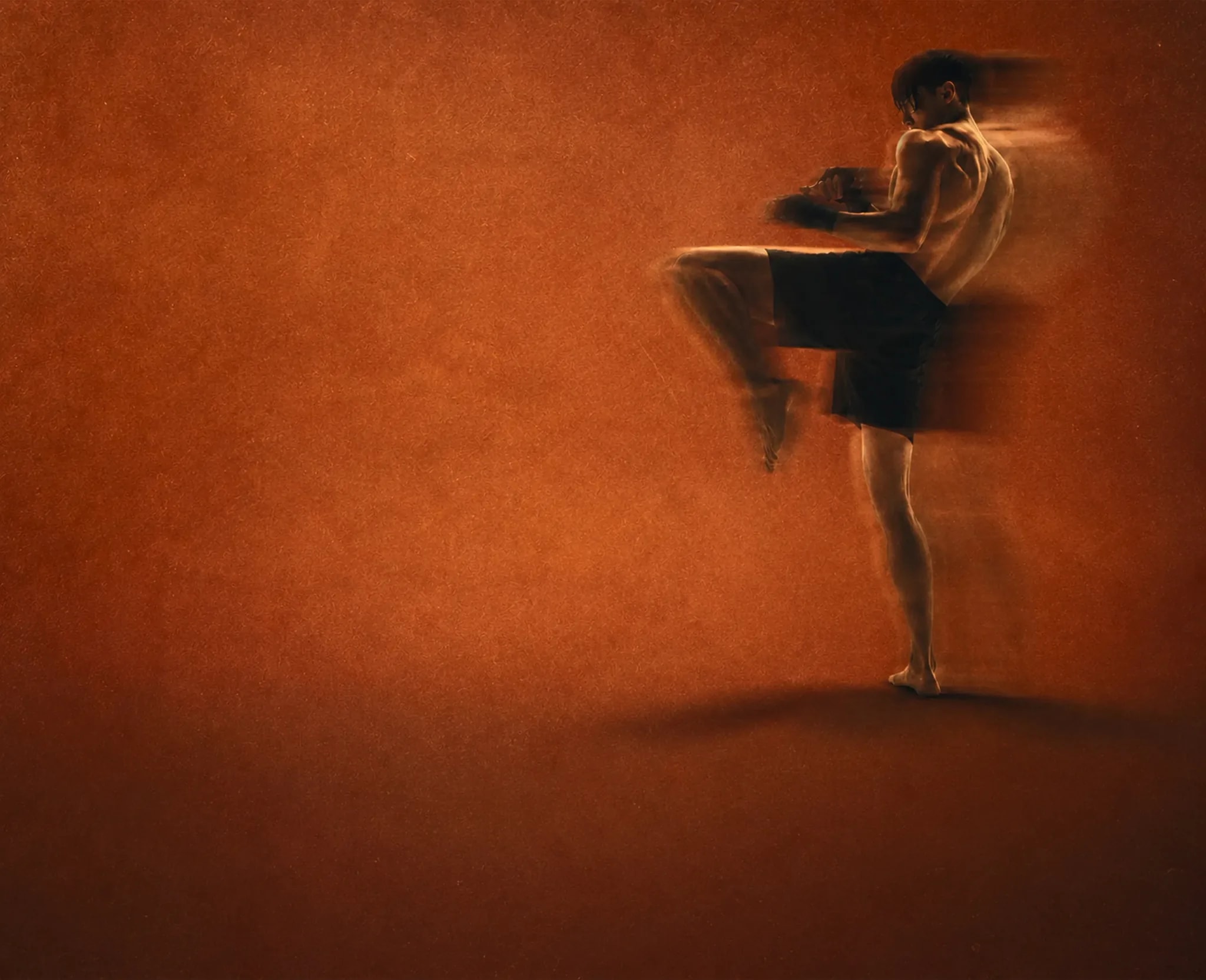
Standing Cable Leg Curl
The standing cable leg curl is a hamstring isolation exercise in which, with an ankle strap on the low pulley and facing the stack, you bend one knee to bring the heel toward the glute.
HAMSTRINGS · LOWER BODY

How it is executed
- Attach an ankle strap to a low cable pulley and fasten it around one ankle while standing facing the stack, holding the frame for balance.
- Keep your standing leg slightly bent and your torso upright as you curl your working heel back and up toward your glute.
- Squeeze the hamstring at the top, flexing only at the knee.
- Return the leg under control until nearly straight, keeping constant tension on the cable.
- Avoid leaning or swinging to keep the hamstring doing the work.
- Muscles worked
- Hamstrings
- Primary muscle
- Hamstrings
- Equipment
- Cable
- Movement pattern
- Lower body
- Difficulty
- Intermediate
- What it is for
- Hypertrophy
Common mistakes
- Standing too close to the stack. With the cable slack, the first part of the curl comes for free and the hamstring loses exactly the stretched position. Move away until the cable is taut with the leg almost straight.
- Driving the thigh back to lift the ankle. That movement is a hip extension and the glute takes over the work. Keep the thigh vertical, resting against the frame if needed, and move only the knee.
- Leaning the torso forward and arching the lower back to touch the glute with the heel. That extra range comes from the back, not the hamstring. Keep the torso upright and accept a shorter range.
- Dropping the lowering phase. If the stack yanks the leg back down, half the rep is lost. Extend the knee over two or three seconds until almost straight, without letting the plate touch the rest of the stack.
Frequently asked questions
- Which muscles does the standing cable leg curl work?
- The main muscles are the hamstrings: biceps femoris, semitendinosus and semimembranosus, which bend the knee against the cable. The gastrocnemius assists the curl because it also crosses the knee, especially if the foot is dorsiflexed. In the supporting leg, the gluteus medius keeps the pelvis level and the quads hold the slight knee bend. The abs and spinal erectors anchor the torso so the leg moves on its own.
- Standing cable leg curl or machine leg curl: which is better?
- The machine, lying or standing, locks the hip in place with a pad and lets you move far more load, so it is the better option for progressing strength and size. The cable version works one leg at a time with less weight, demands balance and leaves the thigh angle free. It earns its place when there is no machine, to even out a weaker leg, as activation before deadlifts or as a finisher with long sets.
- How many sets and reps of standing cable leg curls should you do?
- A common starting point is 3 sets of 12 to 15 reps per leg, with 1 or 2 reps in reserve and a two to three second lowering. Since it is an isolation exercise with light loads, it responds better to long, controlled sets than to heavy weights. It usually comes after a Romanian deadlift or a hip thrust, once the hamstrings have already worked in a stretched position, or at the end of the leg session.
- Where does the ankle strap go and which way should the foot point in the cable leg curl?
- The strap fastens just above the ankle, snug, with the ring at the back so the cable pulls in line with the leg. With the toes pointed, the gastrocnemius is shortened and helps less, so the hamstring works more on its own. With the foot dorsiflexed, the calf joins in and you can move a bit more weight. Pick one position and keep it on every rep so the load stays comparable.
Sources and editorial approach
The explanation, variations and FAQs are Kaizer’s editorial synthesis. ACSM’s 2026 guidance provides general context on progression and resistance training in healthy adults; it does not independently validate the technique of each variation.
No individual professional review is recorded for this page.
Put it to work in Kaizer
Create workout routines with AIFrom goals and equipment to an editable routine in minutes — one that keeps adapting itself, session by session.The best Harbiz alternatives in 2026The alternatives, including what each one does better.Pricing and plansBasic supports up to 3 clients from USD 5 a month.
Glossary and calculators
MacrocycleA macrocycle is the long planning horizon, typically six months to a year, grouping every mesocycle that leads to a larger goal.Zone 2 (aerobic base)Zone 2 is the aerobic intensity between 60 and 70% of heart-rate reserve, sustainable for a long time and low enough to hold a full conversation.Estimated 1RM calculatorWhat is your estimated 1RM?