Loads adjust on their own after every session.
From what your client logs in each workout, Kaizer calculates the weight for their next weeks.
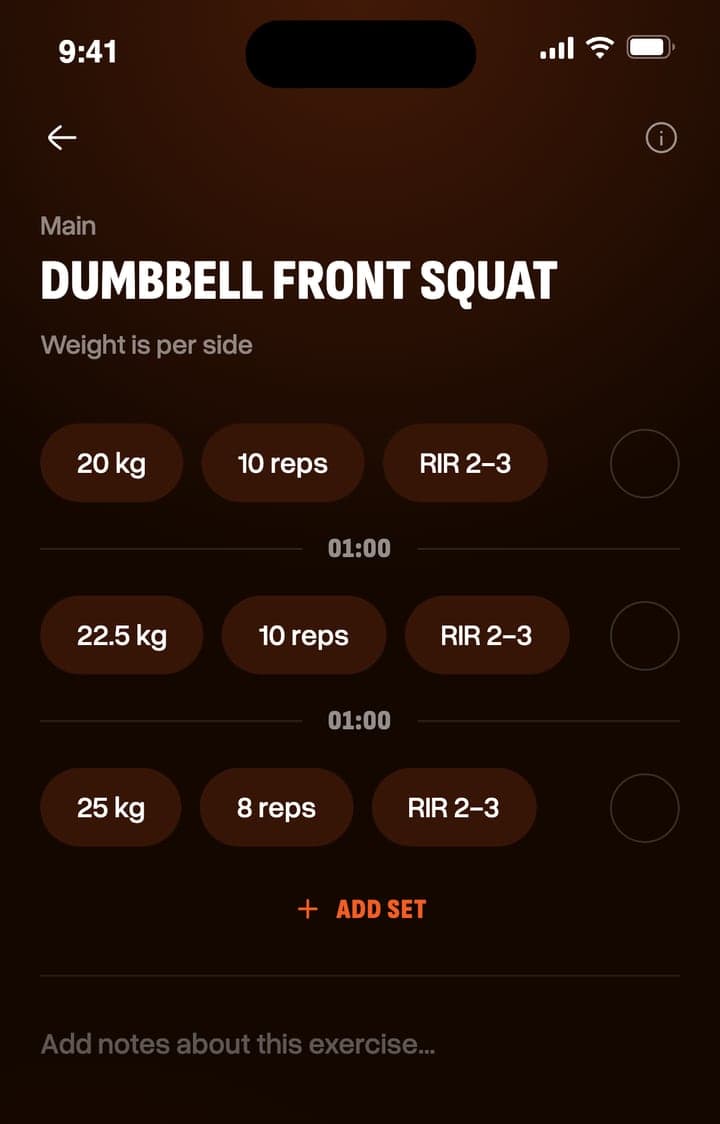
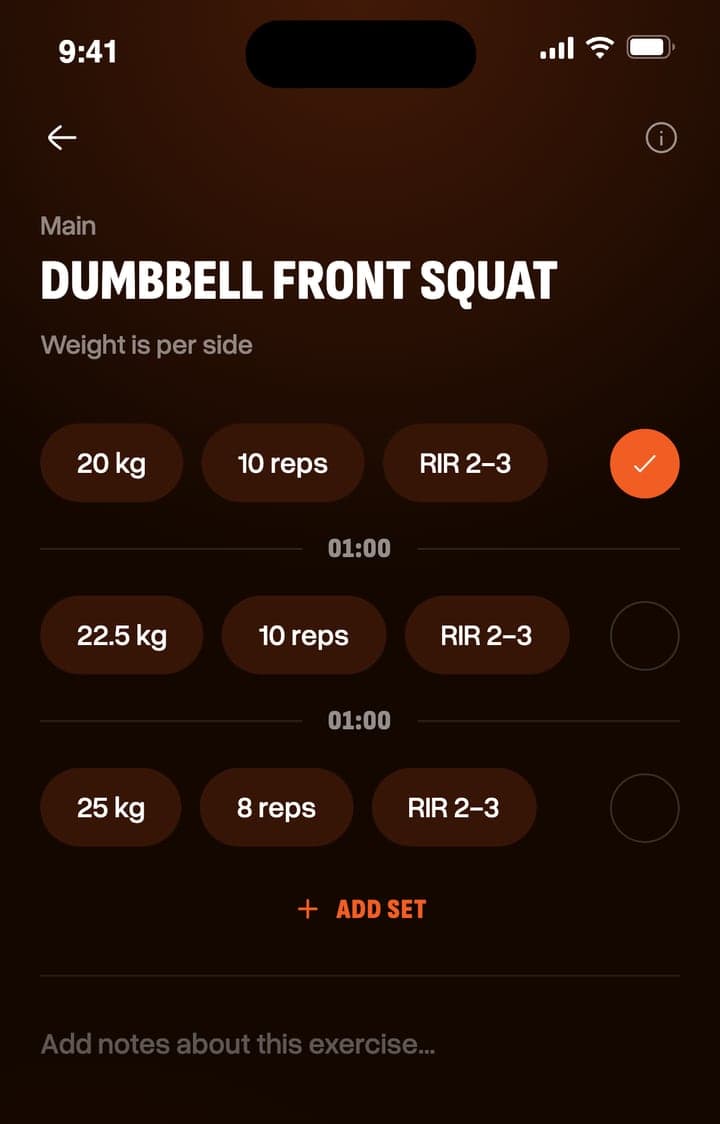
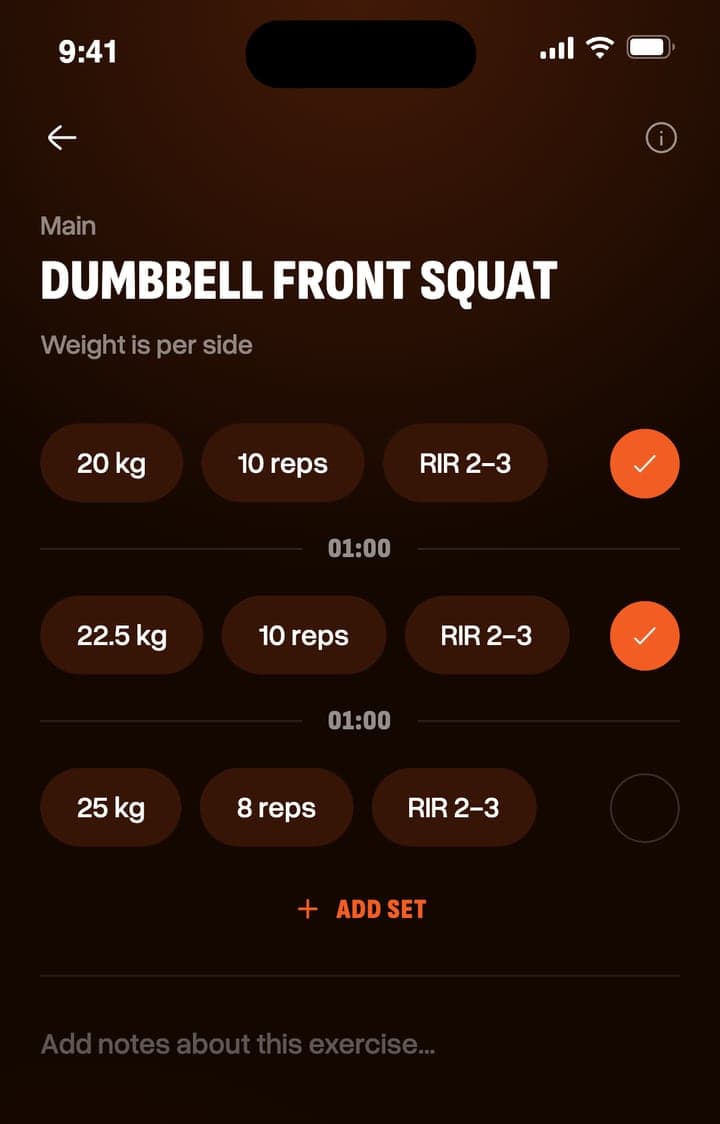
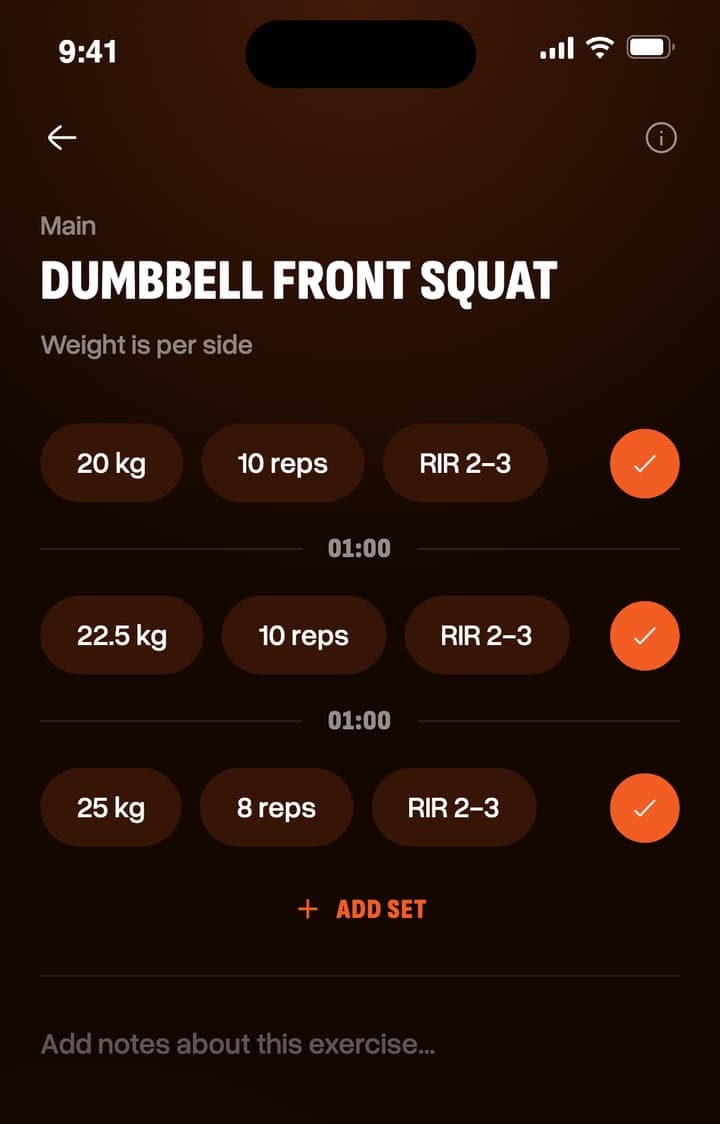
Your client logs the workout.
Weight and reps for each set, plus RIR, from their app.
How Kaizer decides each weight.
Four simple rules, and you stay in control.
You choose who gets adjusted.
Turn it on for all your clients or only some. Anyone you turn it off for keeps the weights they logged last time.
Weights you can actually load.
If the math says 64.3 kg, Kaizer prescribes 62.5: it rounds down to the minimum increment you set for that exercise and drops the rest.
Not enough for more weight? More reps.
When the improvement is smaller than the minimum increment, the weight holds and the target reps go up: from 60 kg × 8 to 60 kg × 10.
One bad day does not change the whole plan.
Kaizer averages the exercise's last three sessions within 56 days. One very bad, or very good, session does not send the weights flying.
What each plan includes
Choose by client count and the tools you need. USD list prices with monthly billing.
- Basic
- USD 5 / month
- 3 clients
- Load progression included
- Starter
- USD 19 / month
- 15 clients
- Load progression included
- Pro
- USD 49 / month
- 50 clients
- Load progression included
- Arnold
- USD 149 / month
- 500 clients
- Load progression included
Progression adjusts loads and repetitions. Generating a new routine with AI starts with Starter.
Compare all plans →Assisted progression FAQ.
No. It calculates loads; the judgment stays yours. You switch it on or off overall and per client, and any week you edit leaves the calculation for good. It does not program deloads or read signals like sleep, pain or adherence: that is still the trainer's job.
When the session closes, it averages the weight and reps of the completed sets, adds the RIR the client reported and estimates the 1RM with an NSCA-derived coefficient table. That 1RM is averaged with the last three executions of the exercise within 56 days, then multiplied by the coefficient for the reps and RIR you prescribed for each following week. The result is rounded down to the exercise's minimum increment.
No. It is deterministic arithmetic over a coefficient table: the same log always gives the same load, and no language model is involved. Kaizer's AI lives elsewhere in the product, such as routine creation and the assistant.
You change it. Open the routine as a week-by-week table and edit weight, reps or RIR. The calculation never touches that week again. If you want nothing recalculated for a client, switch their progression off and the next weeks repeat what they logged.
Yes. With no previous executions, the calculation uses today's session alone and starts averaging from the next one. If the client does not report RIR, it is taken as 0: the most conservative reading, because it underestimates the 1RM rather than inflating it.
If the gap between the calculated weight and last week's is smaller than the exercise's minimum increment, the weight stays and the rep target goes up. A small improvement becomes one more rep, not a weight nobody can load.
Start by confirming they are actually stuck rather than having a bad week. In our own data, across 19,536 client-exercise pairs, 68% have their record in the most recent logged session and only 5.5% have gone more than 90 days without beating it, so a genuine plateau is rarer than it feels from the inside. When it is real, the current load usually sits almost 18% below the record. What works is to stop pushing load and move a different variable: drop intensity for a week, add volume at a higher RIR, or change the angle with an incline or dumbbell press and come back to the flat bar in three weeks.
There are two possibilities and it is worth separating them before changing anything. One is that the load really is light, and the fix is direct: 4 RIR on a set of 5 works out to about 77% of 1RM, when most strength blocks live between 80 and 87%. The other, more common in newer clients, is that they are underestimating effort: RIR estimation improves with practice, and beginners often say 4 when they had 1 or 2 left. The way to tell is to ask for one genuine set to failure on something safe, like a machine, and compare. Kaizer uses the reported RIR to calculate the next load, so if the reporting runs high, the loads will run high too.
In Kaizer it does not need recalculating: it updates after every session the client logs, from the sets, reps and RIR, using NSCA-derived tables. That is the difference from working off a 1RM test: a number measured in January governs March's loads even though the client has moved on. If you want to test anyway, a real test every 8 to 12 weeks is typical, and it is mainly useful for calibrating the estimate on the main lifts.