Cable Pullover
The cable pullover is a lat isolation exercise done standing at a high pulley, pulling the bar down in an arc with the elbows nearly straight so the back works without help from the biceps.
BACK · PULL
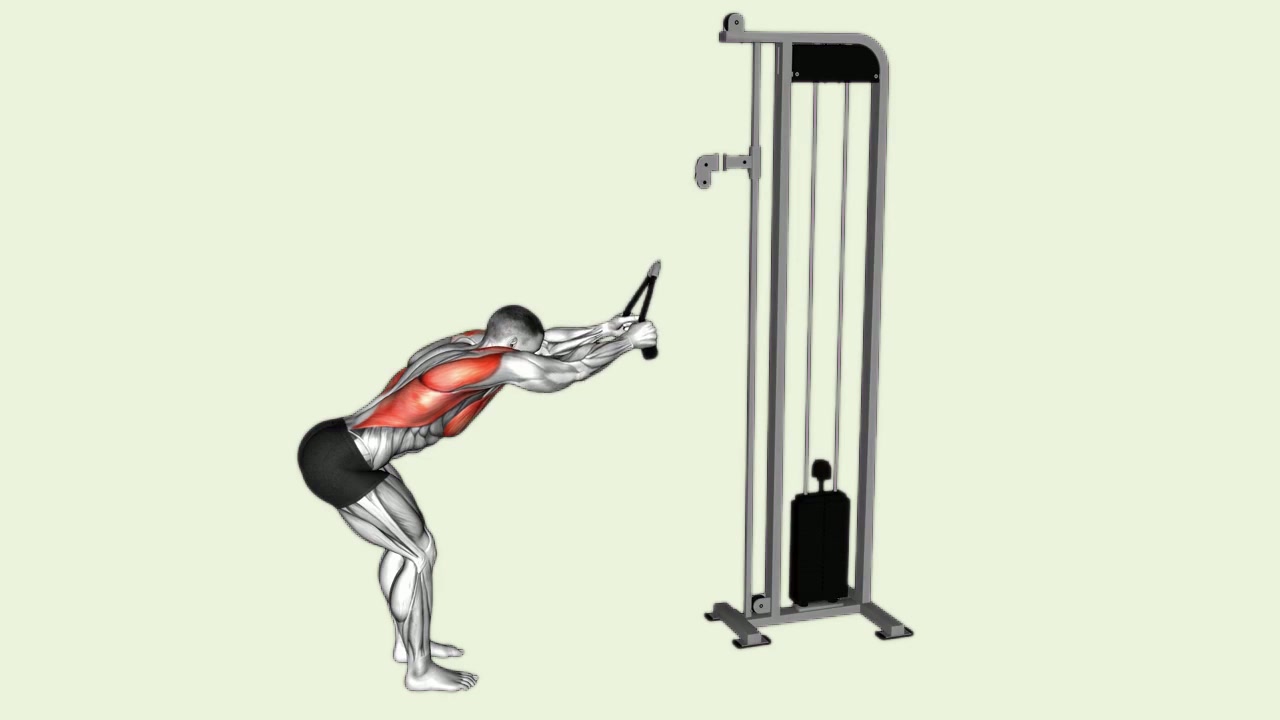
How it is executed
- Stand facing a high pulley holding a bar or rope with arms fully extended.
- Step back slightly to create tension.
- Brace your core and hinge forward just a bit.
- Pull the handle down in an arc until your hands reach your thighs, keeping elbows extended throughout.
- Slowly return to the starting position under control, maintaining constant tension on the lats.
Common mistakes
- Bending and extending the elbows through the rep. That turns the pullover into a pushdown and hands work to the triceps. Hold a slight, constant elbow bend: the movement happens at the shoulder.
- Following the bar with the torso. If you stand up as you pull down, the extra range comes from the hip rather than the lat. Set the hip hinge at the start and hold that angle for the whole set.
- Cutting the top short. Letting the arms travel back overhead is what stretches the lat. Use a load that lets you get there without arching the lower back.
Frequently asked questions
- Which muscles does the cable pullover work?
- The main muscle is the latissimus dorsi, which drives the arm from overhead down to the thighs. The teres major, the long head of the triceps as an elbow stabilizer and the pec at the top of the arc assist. With the hip hinge locked in, the abs work isometrically so the torso does not follow the bar.
- Cable pullover or dumbbell pullover: which one should you pick?
- The cable keeps tension constant through the whole arc, including the finish with the hands at the thighs, where a dumbbell no longer offers resistance. The lying dumbbell version loads the pecs and rib cage more because of the body position. To isolate the lats, the cable is the more direct choice; the dumbbell works when no machine is available.
- How much weight and how many reps for the cable pullover?
- It is an isolation exercise with a long lever, so the load is lighter than it looks. A common range is 10 to 15 reps with a weight that lets you bring the bar down without bending the elbows or standing up out of the hinge. If the last rep needs momentum, the load is too high. Many coaches program it as the second or third back exercise, after a pulldown or a row.
- Why do I feel the cable pullover in my arms instead of my back?
- It is almost always because the elbows bend and straighten during the rep, which turns the movement into a triceps pushdown. Lock in a slight elbow bend and think about driving the arms down from the shoulder, as if you wanted to touch your thighs with your hands. Step a little further from the pulley so the lat is stretched at the start.
Variations and substitutions
Put it to work in Kaizer
Glossary and calculators
PeriodizationPeriodization is organizing training into blocks with different goals and loads over time, so an athlete arrives at a given moment in the best possible state...Training tempoTempo is the prescribed speed of each phase of a rep, written as four numbers: eccentric, pause at the bottom, concentric and pause at the top.Training volume calculatorHow many weekly sets a muscle gets