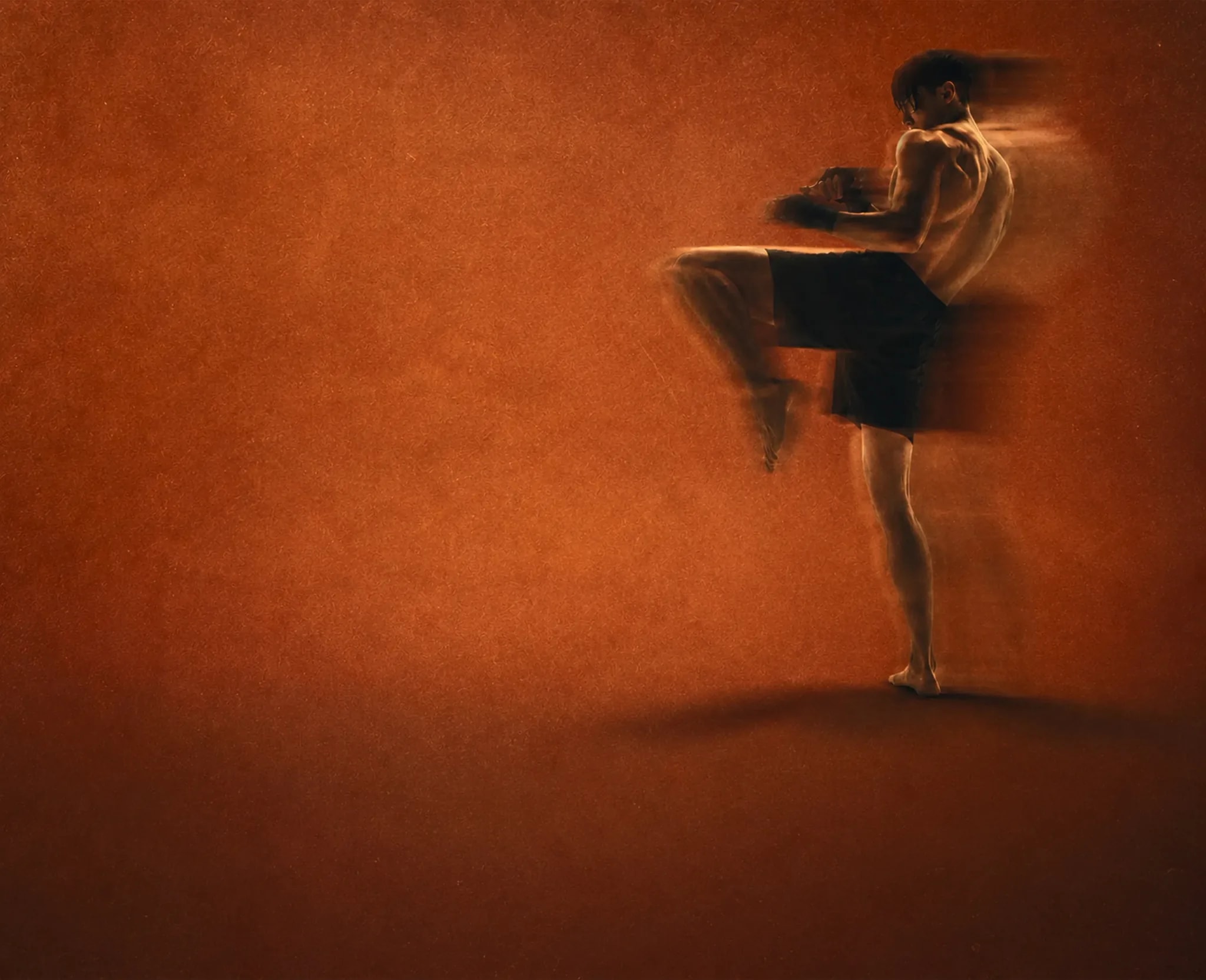
Pendulum Squat
The pendulum squat is a machine squat with the shoulders under the pads and the back supported, pushing a platform that swings in an arc, to squat deep with the torso held and load mainly the quads.
QUADRICEPS · LOWER BODY

How it is executed
- Step onto the platform of a pendulum squat machine with your shoulders under the pads and your back against the support.
- Place your feet shoulder-width on the platform and unlock the machine.
- Descend by bending your knees and hips as the platform swings down in its arc, going as deep as comfortable, then drive through your feet to extend back up.
- The pendulum path keeps constant tension on the quads and supports your spine throughout.
- Muscles worked
- Quadriceps
- Primary muscle
- Quadriceps
- Equipment
- Pendulum squat machine
- Movement pattern
- Lower body
- Difficulty
- Intermediate
- What it is for
- StrengthHypertrophy
Common mistakes
- Lifting the heels at the bottom. With the feet low and lots of depth, the weight shifts to the toes and the knee takes extra load. Keep the heels down; if they lift, move the feet higher or stop a little earlier.
- Going down until the pelvis leaves the pad. At the bottom of the arc the hips want to tuck under and the lower back rounds under load. Stop where the glutes still touch the pad, even if the machine allows more.
- Resting at the top with the knees locked. The top of the arc is where the machine weighs least, and stopping there hands you seconds of rest on every rep. Stop just short of full extension and go back down.
- Bouncing out of the bottom. The low position is the heaviest and most stretched, and using a bounce to get past it throws away exactly what this machine offers. Lower in two or three seconds, pause briefly and drive up.
Frequently asked questions
- Which muscles does the pendulum squat work?
- The quads are the main player: the machine's arc lets the knees travel forward with the torso vertical, and that position loads all four heads, especially at the bottom. The gluteus maximus and adductors extend the hip from the bottom, with a bigger role the higher you place the feet. Hamstrings and calves contribute little. Because the pad supports the back, the erectors rest and the abs keep the pelvis on the seat.
- Pendulum squat or hack squat: how do they differ?
- The hack squat runs on straight rails at a fixed angle, with the same resistance throughout. The pendulum pivots in an arc: the hips drop and move back from the feet, so you go deeper with the pelvis on the pad and the load feels heavier at the bottom and lighter at the top. Pick the pendulum for stretched quad work; the hack squat when you want to move more weight or it is the only option.
- How many sets and reps for the pendulum squat?
- A common starting point is 3 or 4 sets of 8 to 12 reps, leaving 1 to 3 reps in reserve, with a two to three second descent. Because the machine supports the back, it handles long sets of 15 and drop sets well without execution falling apart. It can be the main quad exercise of the day or come after a free squat. Add weight when every set reaches the same depth.
- Where should you place your feet on the pendulum squat?
- Shoulder-width, toes slightly out, and in the middle of the platform as the base position. The lower you place the feet, the more the knees travel forward and the more quads you get; the higher, the more the hip flexes and the more glute comes in. The heels always stay down: if they lift at the bottom, move the feet up a little or reduce the depth. Go down as far as the pelvis stays against the pad.
Sources and editorial approach
The explanation, variations and FAQs are Kaizer’s editorial synthesis. ACSM’s 2026 guidance provides general context on progression and resistance training in healthy adults; it does not independently validate the technique of each variation.
No individual professional review is recorded for this page.
Put it to work in Kaizer
Create workout routines with AIFrom goals and equipment to an editable routine in minutes — one that keeps adapting itself, session by session.The best FitBudd alternatives in 2026The alternatives, including what each one does better.Pricing and plansBasic supports up to 3 clients from USD 5 a month.
Glossary and calculators
1RM (one-rep max)The 1RM is the heaviest load a person can lift once in a given exercise with correct technique.MesocycleA mesocycle is a training block of roughly three to six weeks with one dominant goal, such as accumulating volume or expressing strength.RIR ↔ %1RM conversionWhat percentage of 1RM does your RIR correspond to?